
The 5 marketing strategies that cover the main ways a small business wins customers are search (SEO and content), social media, email and WhatsApp messaging, paid advertising, and referrals and reviews. There is no single official list; this grouping is ours. Together they cover how customers find you, decide to trust you and come back. Start with the one or two your customers already use, and give each a few weeks to show results.
How does each of the 5 marketing strategies work?
Each one does a different job: getting you found, earning trust or bringing customers back. In our view, a small business is better off running two or three marketing strategies well than all five at once.
1. Search: SEO and content marketing
Search marketing means being the answer when someone types a question into Google. Google’s SEO Starter Guide describes SEO as helping search engines understand your content and helping people find your site. For a small business, that means clear pages that answer the questions your customers actually ask.
It is slow but it builds. Google says some changes show within a few hours and others take several months. It suggests waiting a few weeks before judging your work, and says no secret will automatically rank a site first.
Local shops and services should start with a free Google Business Profile. It controls how you appear on Google Search and Maps, with photos and replies to reviews. Freelancers and creators can treat a blog the same way; our guide to earning through blogging covers the money side.
2. Social media marketing
Social media marketing means posting regularly where your customers already spend their time. HubSpot’s 2026 State of Marketing report surveyed more than 1,500 marketers. It calls social media the cornerstone of marketing in 2026, second only to websites, blogs and SEO. Short-form video was the format most often named for the best return, at 48.6%.
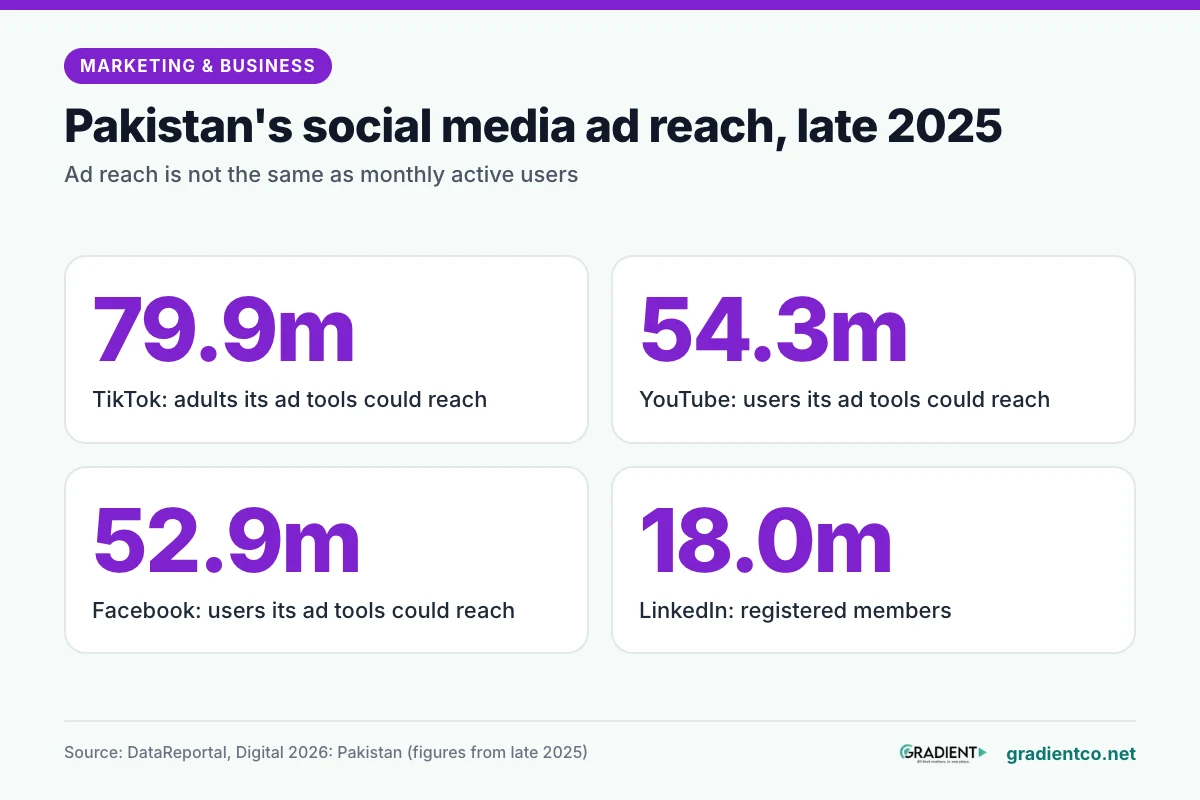
In Pakistan the audience is large but spread across apps. DataReportal’s Digital 2026 Pakistan report counted 79.9 million social media user identities in October 2025, or 31.2% of the population. In late 2025, TikTok’s ad tools reached 79.9 million adults, YouTube 54.3 million users and Facebook 52.9 million. Ad reach is not the same as monthly active users, so treat these as rough sizes.
In our view, one platform done well beats five done badly. A clothing seller might choose Instagram or TikTok, while a freelance developer is better served by LinkedIn, whose ad tools listed 18.0 million registered members in Pakistan in late 2025.
3. Email and WhatsApp marketing
Email and messaging marketing means talking directly to people who have already chosen to hear from you. It suits repeat sales, new stock and reminders. Because you own the contact list, in our view it is the strategy least exposed to changes in a platform’s algorithm.
For small sellers in Pakistan, we think WhatsApp is the natural channel. The WhatsApp Business app is free to download and free to use, and it is built for small businesses. Its feature list includes a business profile, a catalog that works as a mobile storefront, greeting and away messages, quick replies and labels for sorting chats.
Email suits freelancers and anyone selling to clients abroad. Mailchimp’s pricing page lists a free plan for up to 250 contacts and 500 emails a month, as of October 2026. Whichever channel you use, only message people who agreed to hear from you.
4. Paid advertising
Paid advertising buys attention right away, and it stops when the money stops. Google says search ads have no flat fee and you pay only when someone clicks. Under Google’s budget rules, as of October 2026, most campaigns can spend up to twice their average daily budget on a busy day. Over a month, though, a $10 daily budget is capped at $304.
Meta sells ads on Facebook, Instagram, Messenger and WhatsApp through an auction, and usually charges by impressions, the number of times an ad is shown. Its system needs time to learn. An ad set usually leaves the learning phase after about 50 results in a week, and the cost per result is usually higher until then. Minimum budgets vary by country and objective.
If you would rather pay per sale than per click or view, a marketplace is the alternative. On Daraz, as of October 2026, opening a shop is free, and a commission that varies by product category is taken from each order’s payment.
5. Referrals, reviews and word of mouth
Referral marketing turns happy customers into your sales team. Nielsen’s 2021 Trust in Advertising study found word of mouth was the most trusted channel: 88% of respondents worldwide said they trust recommendations from people they know. Google’s SEO guide calls word of mouth one of the most effective and lasting ways to promote a site, though it takes time.
Make recommending you easy. Ask every satisfied customer for a review on your Google Business Profile, reply to every review, and thank people who send friends your way. Working with creators is a paid version of the same idea. In HubSpot’s survey, respondents reported the most success with micro-influencers (32.4%).
How do the 5 marketing strategies compare?
Search and referrals are cheap but slow; paid ads are fast but cost money every day. Times marked “our estimate” are our judgement, not a published figure.
| Strategy | Best for | Cost | Time to results | First step |
|---|---|---|---|---|
| Search (SEO, content) | Services and shops people search for | Free to start; costs your time | Hours to several months (Google) | Claim a free Google Business Profile |
| Social media | Visual products, creators | Free to post; ads optional | Weeks of steady posting (our estimate) | Pick one platform and post weekly |
| Email and WhatsApp | Repeat buyers, sellers with a catalog | WhatsApp Business app free; Mailchimp free up to 250 contacts | Days, once you have a list (our estimate) | Set up a WhatsApp Business profile and catalog |
| Paid ads | Testing an offer, seasonal sales | You set a daily budget | Days (our estimate); Meta needs about 50 results in a week to stabilise | Run one small test with one offer |
| Referrals and reviews | Local services, high-trust purchases | Low: a thank-you or small reward | Slow but lasting (Google) | Ask happy customers for a review |
What are marketing techniques, and how do they differ from strategies?
Marketing techniques are the specific actions you take to carry out a strategy. Think of a Reel, a discount code, an email subject line or a referral card. The strategy is the bigger choice: who you serve, what makes you different and which channels you use.
The American Marketing Association (AMA) describes a marketing strategy as a long-term blueprint for how a business creates and delivers value to customers. A marketing plan, it says, details the specific actions and tactics needed to carry that strategy out. The US Small Business Administration (SBA) draws the same line. Your business plan holds the core of your marketing strategy, it says, and your marketing plan turns it into action.
Imagine a home baker in Lahore whose strategy is to be the custom birthday cake maker for her neighbourhood. Her marketing techniques might be a WhatsApp catalog, short videos of finished cakes and a review request after each order. When a technique stops working she can swap it; the strategy changes only when her customers or her offer change.

How to create a marketing strategy in 6 steps
Build the plan on paper before you spend money on any channel. These steps follow the AMA’s step-by-step guide and the SBA’s marketing plan sections, simplified for a small team or a one-person business. If you have not written a business plan yet, start with our guide on how to start a business plan.
- Define your customer. Write down who buys, where they live, what they search for and which apps they use. The SBA asks for the market’s size, demographics and trends.
- Say why they should pick you. One sentence on your advantage: the SBA’s examples are a better product, a lower price or an excellent customer experience.
- Set one measurable goal. The AMA recommends SMART goals, meaning specific, measurable, achievable, relevant and time-bound, such as a set number of new customers each month.
- Choose one or two marketing strategies from the table. Match them to your customer, your budget and how fast you need results. A new shop with no budget might pair a Google Business Profile with WhatsApp; a seller testing a new product might add a small paid test.
- Plan the techniques and the budget. List what you will post, send or run each week, who does it and what it costs. The AMA’s action plan covers a timeline, responsibilities and a budget.
- Measure, then adjust. Compare what you spent with the sales it brought in, and ask new customers how they heard about you. The SBA says to revisit a marketing plan at least once a year.

Measuring is often the hard part. In HubSpot’s 2026 survey, measuring the return on marketing was the top challenge, cited by 33% of marketers. The SBA notes that some tactics, such as word-of-mouth campaigns, are hard to measure.
Frequently asked questions
What are the 5 marketing strategies?
There is no official list. The five most small businesses use are search (SEO and content), social media, email and WhatsApp messaging, paid advertising, and referrals and reviews. Start with one or two.
Are the 5 marketing strategies the same as the 4 Ps of marketing?
No. The AMA describes the four Ps, product, price, place and promotion, as the key factors of any marketing strategy. The five strategies in this guide are ways of doing the fourth P, promotion.
What are marketing techniques?
Marketing techniques are the individual actions inside a strategy, such as a short video, a discount code, an email or a referral reward. The strategy decides who you target and which channels you use; techniques are what you do there each week.
What is the cheapest marketing strategy for a small business?
Referrals, search and WhatsApp cost little money but take time. A Google Business Profile and the WhatsApp Business app are both free, so the main cost is the hours you put in.
Which marketing strategy works best in Pakistan?
It depends on your customers. DataReportal counted 79.9 million social media user identities in Pakistan in October 2025, and the WhatsApp Business app is free. In our view, social media plus WhatsApp is a practical start for many local sellers.
What we do not know yet
We could not open the Pakistan Telecommunication Authority’s statistics pages, so the Pakistan figures here come from DataReportal. We found no official data on which marketing strategies bring the best return for small businesses in Pakistan. We also found no current official count of WhatsApp Business users in the country.
Read next: How to start a business plan, the document your marketing strategy should sit inside.
Researched and drafted with AI assistance; facts checked against the sources linked in this article.
Featured image: Anarkali Pakistan by TheWazir, CC BY 2.0.


Comments are closed.