The IceCube Neutrino Observatory is a cubic kilometre of Antarctic ice fitted with 5,160 light sensors. It catches neutrinos, tiny particles that pass through almost everything. On 6 October 2026, the scientist behind it, Francis Halzen of the University of Wisconsin–Madison, won the Nobel Prize in Physics 2026. Its discovery of high-energy neutrinos from far beyond our solar system opened a new way to study the universe.
What did the Nobel Prize in Physics 2026 reward?
The prize rewards one man’s idea and the detector it became. The Royal Swedish Academy of Sciences gave the award to Francis Halzen alone, “for decisive contributions to the IceCube Neutrino Observatory and the discovery of high-energy neutrinos of astrophysical origin”, according to the Nobel press release.
Halzen was born in Tienen, Belgium, on 23 March 1944, so he is 82, says his Nobel facts page. He first presented the idea of a neutrino detector in South Pole ice in 1988, with colleague John G. Learned, at a conference in Poland. Mark Pearce, who chairs the Nobel Committee for Physics, said Halzen’s vision “has paved the way for a new kind of astronomy.”
| IceCube at a glance | What the sources say |
|---|---|
| Location | Near the Amundsen-Scott South Pole Station, Antarctica |
| Size | One cubic kilometre of ice, about a billion tonnes |
| Sensors | 5,160 digital optical modules on 86 strings |
| Depth of sensors | 1,450 to 2,450 metres below the surface |
| Completed | Last string lowered on 18 December 2010, after seven Antarctic summers of work |
| Construction cost | $279 million, about $242 million of it from the US National Science Foundation |
| Collaboration (October 2026) | About 450 scientists from 58 institutions in 14 countries |
| Nobel prize amount | 12 million Swedish kronor |
The detector figures come from IceCube’s detector page and the collaboration size from its Nobel announcement.
What are neutrinos, and why are they called ghost particles?
Neutrinos are tiny particles with no electric charge and almost no mass. Because they barely interact with anything, they fly straight through planets, people and walls. The Nobel committee’s popular science summary puts it vividly: every second, 65 billion neutrinos from the Sun pass through your little fingernail.
That is why they are called “ghost particles”, a nickname IceCube uses in its 2018 announcement. Very rarely, a single neutrino collides with the nucleus of an atom. That rare collision is the only moment anyone can detect it.
Most neutrinos come from the Sun, from radioactive decay, or from cosmic rays striking our atmosphere. A tiny share carry huge energy and come from violent places far out in space. Those are the ones IceCube was built to find.
How does the IceCube neutrino observatory catch them?
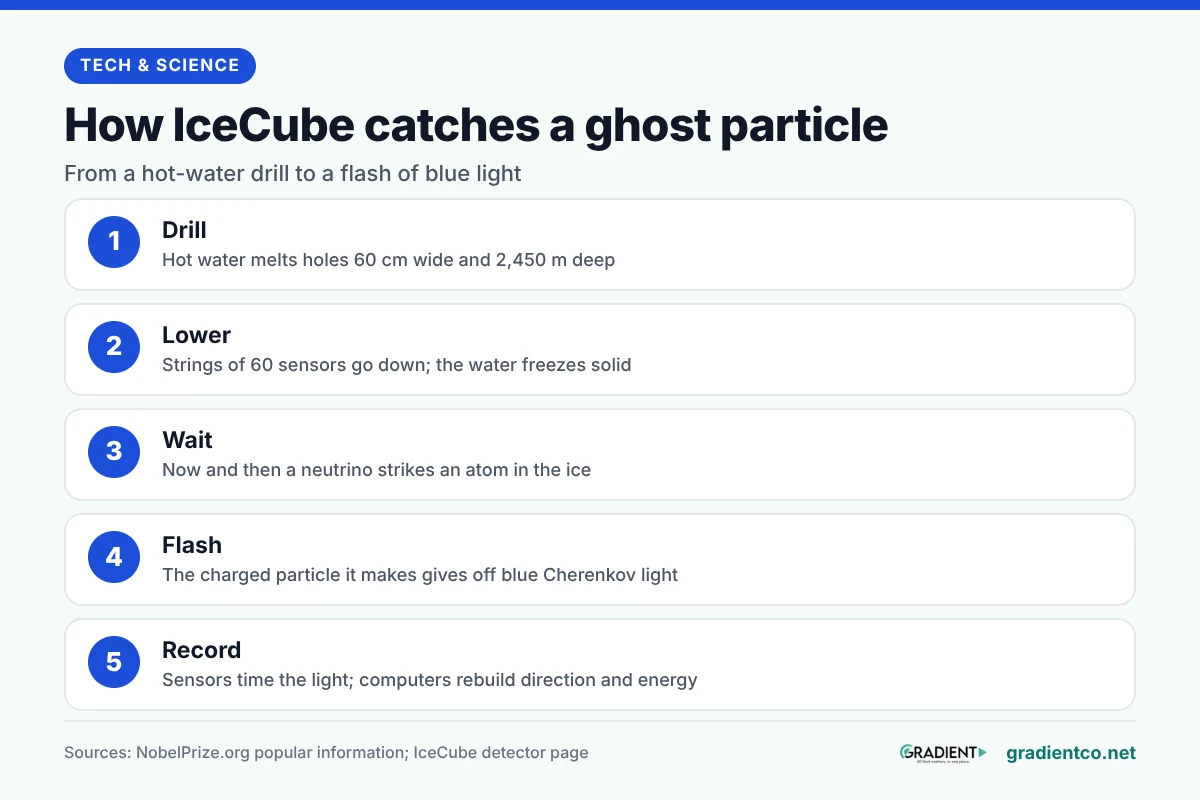
IceCube turns clear, deep ice into a giant camera that films flashes of blue light. Halzen calls each sensor “a lightbulb in reverse”: it takes in light and turns it into an electric signal. Here is the process, step by step.
- Drill: crews melted holes 60 centimetres wide and 2,450 metres deep with a hot-water drill, which cut through the ice at about 2 metres a minute.
- Lower: strings of 60 sensors went down each water-filled hole, which then froze solid. Work was only possible from November to February.
- Wait: a neutrino occasionally strikes an atom in the ice and creates a charged particle.
- Flash: that particle moves through ice faster than light itself travels in ice, so it gives off a faint blue glow called Cherenkov light.
- Record: the sensors time-stamp the light, and computers in the IceCube Lab on the surface rebuild the particle’s direction and energy.
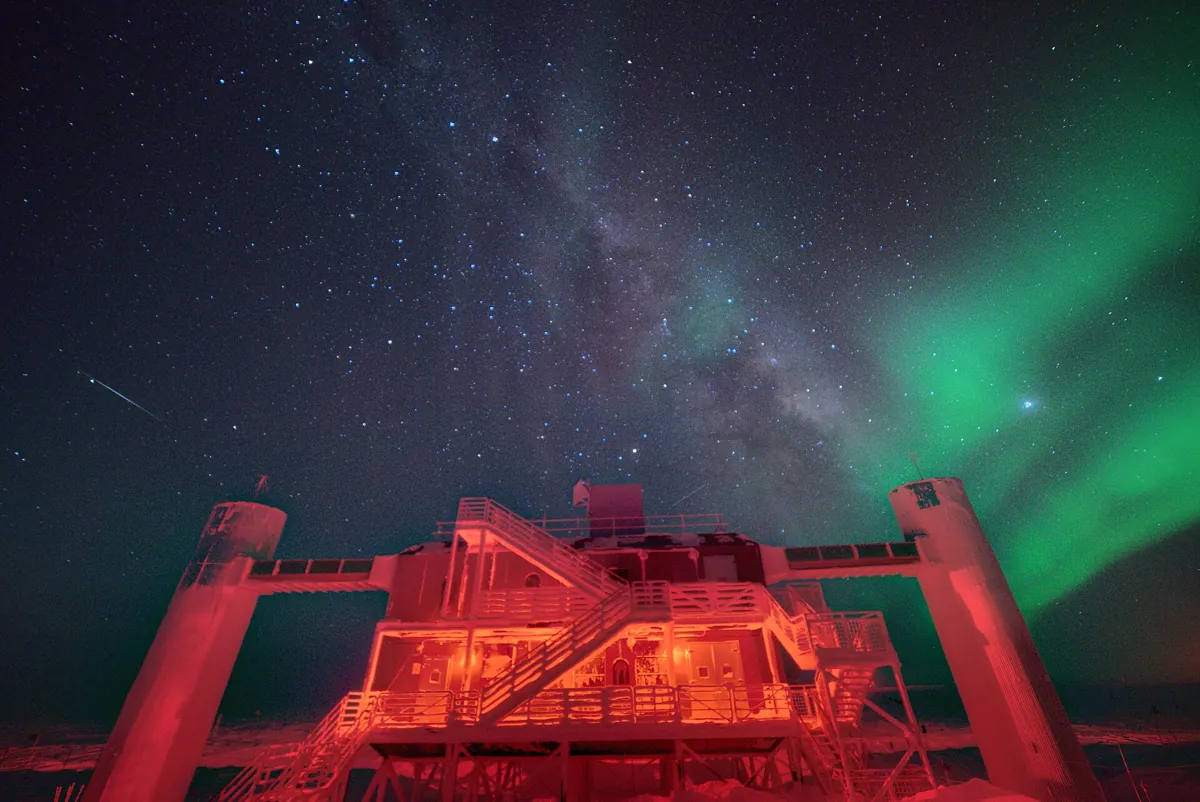
The South Pole suits the job for several reasons. Below about 1,400 metres the ice is extremely pure, and light can travel 300 metres before it is absorbed, the Nobel summary says. Deep down it is always dark, there are no living creatures to interfere, and the area has no earthquakes. A research station was also already there.
The hardest part is sorting out the noise. IceCube registers over a hundred million particles a day from cosmic rays hitting the air above Antarctica. So scientists test whole groups of events. They check if the group, taken together, looks like neutrinos from space rather than from the air.
What has IceCube found?
IceCube proved that high-energy neutrinos reach us from deep space, then started tracing where they come from. The IceCube team published each result below in a peer-reviewed journal.
- 2013, the first cosmic neutrinos: the team found two events of about 1 petaelectronvolt (PeV), or 1,000 teraelectronvolts (TeV). Then came 28 high-energy neutrinos in the same data, according to the Nobel scientific background. By 2014, the team had ruled out that they all came from our own atmosphere.
- 2017, a blazar: on 22 September 2017, IceCube caught a neutrino of about 290 TeV and sent an alert to telescopes within a minute. About 20 observatories followed up and traced it to TXS 0506+056, a blazar about 4 billion light-years away. A blazar is a galaxy whose huge black hole fires a jet of particles at Earth.
- 2022, a hidden galaxy core: IceCube reported about 80 neutrinos from NGC 1068, also called Messier 77, in its November 2022 release. It is an active galaxy 47 million light-years away. A ring of dust blocks most high-energy radiation from its core, but neutrinos slip out.
- 2023, our own galaxy: using 60,000 neutrinos from 10 years of data, IceCube produced the first picture of the Milky Way in neutrinos, its June 2023 release says. Machine learning from TU Dortmund University helped sort real signals from noise. Read more in our piece on algorithms and the modern world.
The sources are still being confirmed. The Nobel committee notes that the NGC 1068 evidence “is not robust enough to definitively identify” the galaxy as a neutrino source. More data should settle it.

Why does neutrino astronomy matter?
Neutrino astronomy lets scientists see places that light cannot reach. Astronomy has always relied on light, from radio waves to gamma rays. But light gets absorbed by dust and gas, and the most violent regions of space are often hidden behind both.
Neutrinos also point straight home. Cosmic rays, mostly protons, carry a charge, so magnetic fields in space bend their paths. Neutrinos have no charge, so they fly in a straight line and keep their energy. The IceCube neutrino observatory, the first gigaton neutrino detector ever built, according to IceCube, turned that idea into data.
This helps solve what the Nobel committee calls one of the universe’s best-kept secrets: where the strongest cosmic rays come from. Something in space fires cosmic rays at Earth with up to a million times the energy of our best machines. The same cosmic engines should make neutrinos too. In our view, that is the real prize here: a new sense for studying the universe, not just a new telescope.
What does this have to do with Abdus Salam?
Pakistan’s own Nobel physicist helped explain the force IceCube relies on. A neutrino reacts with atoms through the weak force. That force is what lets one, now and then, hit an atom in the ice.
Abdus Salam was born in Jhang Maghiana, in what is now Pakistan, in 1926. He shared the 1979 physics Nobel for joining the weak and electromagnetic forces into one theory, “including, inter alia, the prediction of the weak neutral current”, says his Nobel facts page. Neutral-current collisions are one of the ways neutrinos leave a glowing burst in IceCube, according to the Nobel scientific background.
For a Pakistani student reading about this year’s prize, that is a direct line back to Salam’s work. For more on atoms and how all life is built from them, read our explainer Atoms of Life.
What comes next after IceCube?
Bigger and sharper detectors are on the way, at the South Pole and under the sea. The IceCube Upgrade put five new strings inside the existing IceCube neutrino observatory, with 750 new sensors and calibration devices, says IceCube’s page on what lies beyond IceCube. It was installed in 2025–2026, and IceCube expects its first science data later in 2026, according to its Nobel announcement.
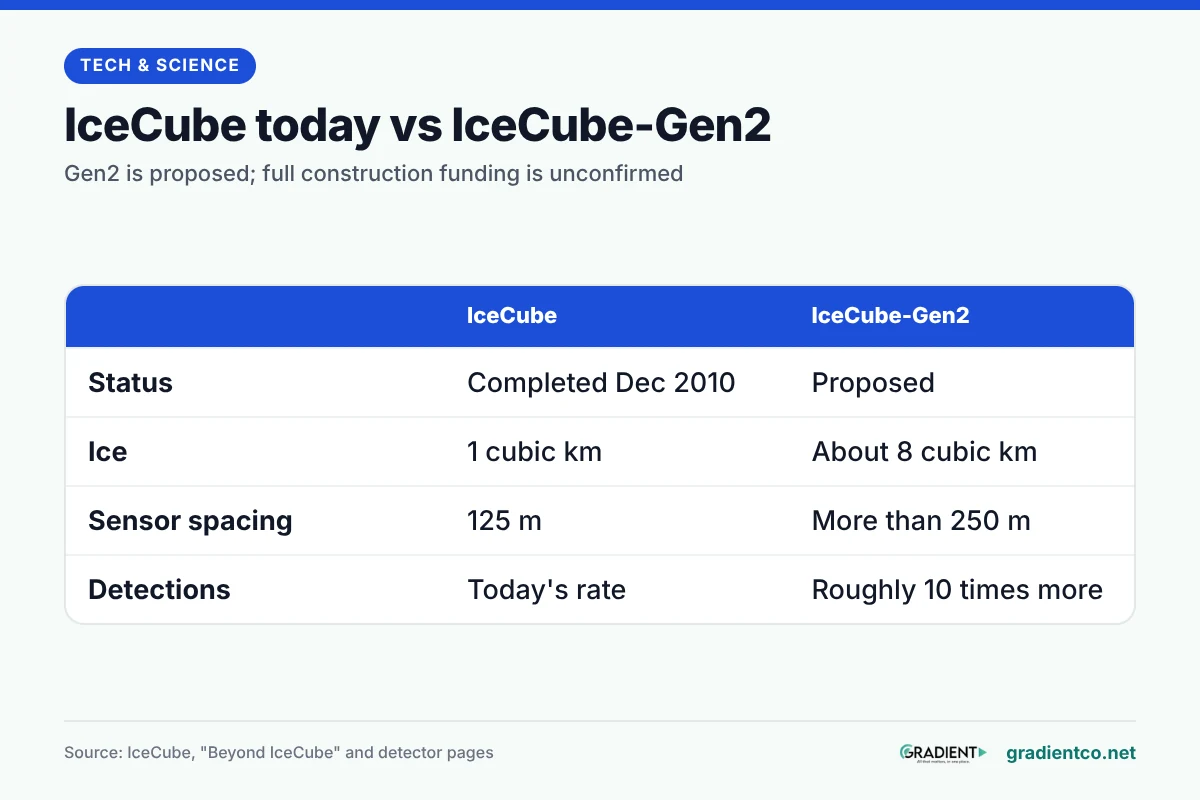
IceCube-Gen2 is the proposed next step. It would space sensors more than 250 metres apart, instead of 125. The detector would grow to about 8 cubic kilometres and aim for roughly ten times more detections.
Other neutrino astronomy projects use water instead of ice. KM3NeT, deep in the Mediterranean Sea, detected the most energetic neutrino ever seen, about 220 PeV, on 13 February 2023, as its collaboration reported in Nature in 2025. It did so with only a tenth of its planned detector built. Similar projects are under way in Lake Baikal, the South China Sea and off Canada’s Pacific coast.
Frequently asked questions
Who won the Nobel Prize in Physics 2026?
Francis Halzen of the University of Wisconsin–Madison won it alone, for his key role in building IceCube and finding high-energy neutrinos from space. The prize is worth 12 million Swedish kronor.
Who is Francis Halzen?
Francis Halzen is a physicist born in Tienen, Belgium, on 23 March 1944. He earned his PhD at KU Leuven in 1969 and is a professor at the University of Wisconsin–Madison. He leads IceCube and first proposed a detector in South Pole ice in 1988.
What is the IceCube neutrino observatory?
It is a neutrino detector built into one cubic kilometre of ice at the South Pole. It has 5,160 light sensors on 86 strings, buried between 1,450 and 2,450 metres deep, and was completed in December 2010.
Why is a neutrino called a ghost particle?
A neutrino has no electric charge and almost no mass, so it rarely interacts with matter. Billions pass through your body every second without leaving a trace.
How does IceCube see something invisible?
The IceCube neutrino observatory does not see the neutrino itself. When a neutrino hits an atom in the ice, it makes a charged particle that gives off faint blue Cherenkov light. The sensors record that flash.
What was IceCube’s biggest discovery?
In 2013 it found the first high-energy neutrinos from outside our solar system. It later linked neutrinos to the blazar TXS 0506+056 in 2017 and saw the Milky Way in neutrinos in 2023.
What we do not know yet
We could not confirm when the IceCube Upgrade’s first science results will be published, or whether IceCube-Gen2 has full construction funding; the sources call it proposed. NGC 1068 is a strong candidate, not a confirmed neutrino source. We will update this article as results arrive.
Read next: Atoms of Life, our look at how life is built from atoms.
Researched and drafted with AI assistance; facts checked against the sources linked in this article.
Featured image: The ICL at Dawn by John Hardin, CC BY 4.0.