
What is chirality? It is handedness in molecules: a chiral molecule and its mirror image cannot be laid exactly on top of each other, just as your left hand will not fit a right-hand glove. Life is built from only one hand of each, and medicines often work in one hand only. On 7 October 2026, the Nobel Prize in Chemistry went to Henri Kagan and Kenso Soai for showing how chemistry can tip towards one hand.
What is chirality, in plain words?
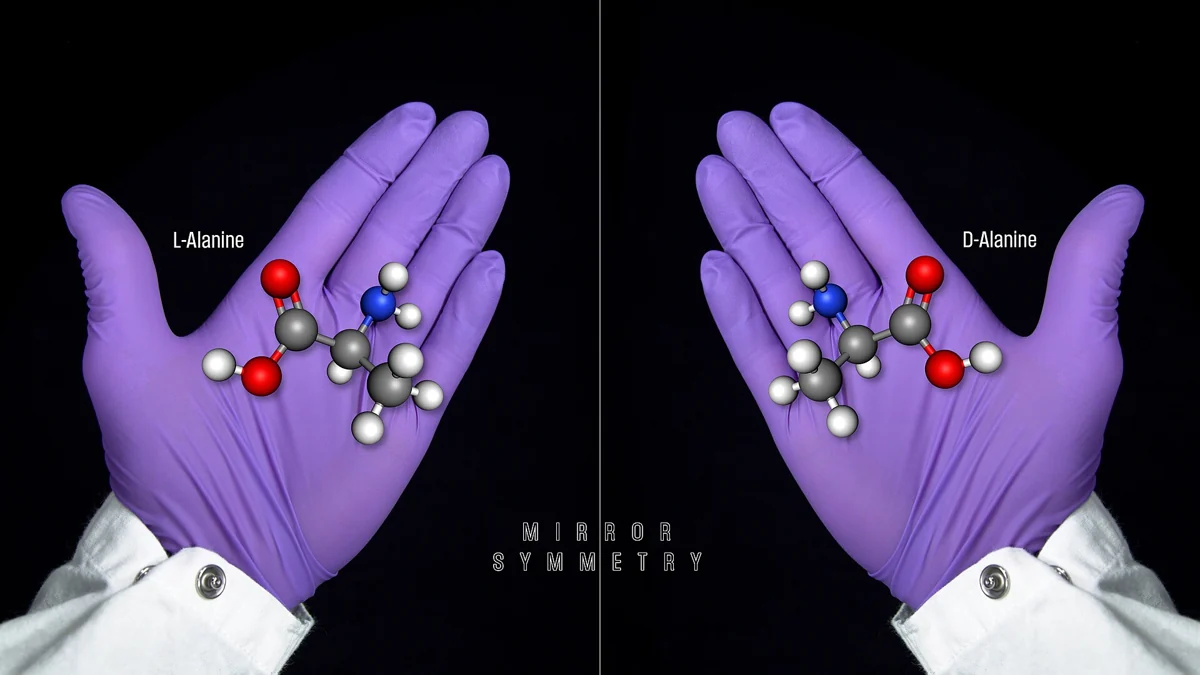
Chirality means a molecule has a non-identical mirror twin. Hold your hands up, palms facing you. They are mirror images, yet you cannot stack one perfectly on the other. Chemists call the two mirror forms of a molecule enantiomers, which the Nobel committee’s scientific background defines as a pair of molecules that are mirror images and “not superposable”.
The idea began with Louis Pasteur in the mid-19th century. According to NobelPrize.org’s popular explainer, he grew crystals of tartaric acid, a substance important in wine making, and saw they came in two mirror-image shapes. He sorted them with tweezers and dissolved each pile: one solution bent polarised light to the right, the other to the left, and a mix of the two did not bend it at all. That tweezers experiment is still the simplest answer to what is chirality.
That 50:50 mix is called a racemate. The US Food and Drug Administration notes that mirror image molecules have essentially identical physical and chemical properties, except in how they rotate light and act in a chiral environment. Your body is a chiral environment, so the difference matters. Same atoms, same bonds, opposite hands: that is the core idea.
Who won the Nobel Prize in Chemistry 2026, and for what?
Henri B. Kagan of France and Kenso Soai of Japan share the prize. The official press release gives the citation as “for the discovery of non-linear effects and autocatalysis in asymmetric organic synthesis”. Put simply, they found ways to make a reaction favour one mirror image, and to grow a tiny lead into near-total control.
| Nobel Prize in Chemistry 2026 at a glance | Details |
|---|---|
| Announced | 7 October 2026, by the Royal Swedish Academy of Sciences |
| Laureates | Henri B. Kagan and Kenso Soai, one half each |
| Henri B. Kagan | Born 15 December 1930, Boulogne-Billancourt, France; Professor Emeritus at what was then Université Paris-Sud |
| Kenso Soai | Born 1950, Hiroshima, Japan; Professor Emeritus, Tokyo University of Science |
| Key years | 1986 (Kagan’s non-linear effect); 1995 and 2003 (Soai’s reaction) |
| Prize money | 12 million Swedish kronor, shared equally |
Kagan was 95 at the announcement, going by his laureate page; Soai’s page lists only his birth year. Heiner Linke, chair of the Nobel Committee for Chemistry, said the pair had solved “a chemical mystery that is over a century old: how homochirality can emerge spontaneously.”
Why does life use only one mirror image?
Nobody knows for sure, and that is the puzzle behind this prize. Life is homochiral, from the Greek words for “same” and “hand”. The proteins in your cells use only one mirror form of each amino acid, and the other form is rarely found in nature, says NobelPrize.org. The sugars in DNA are also one-handed.
Chemists label the natural forms L-amino acids and D-sugars. In 1857, Pasteur saw an early hint: bacteria fermented the tartaric acid found in grapes but left its mirror twin untouched.
Ordinary chemistry does not pick a side. Making amino acids without any outside chiral push “invariably results in the formation of a racemate”, the committee writes. For a primer on the atoms these molecules are made of, see our piece on the atoms of life.
In 1953, Charles Frank, a theoretical physicist at the University of Bristol, proposed an answer on paper. His model needed three things:
- A chiral catalyst that makes one mirror image faster than the other.
- A way to boost one form while holding the other back.
- Autocatalysis: the product acts as the catalyst for making more of itself, so one form grows exponentially.
Kagan supplied the second condition and Soai the third.
Why does chirality matter for medicines?
A drug and its mirror image can act very differently in the body. NobelPrize.org compares it to a locksmith who always makes keys in mirrored pairs: only one fits the lock, and the other can damage it. Many drug molecules come in two forms, where one has the therapeutic effect and the other can cause “unnecessary and sometimes harmful side effects”.
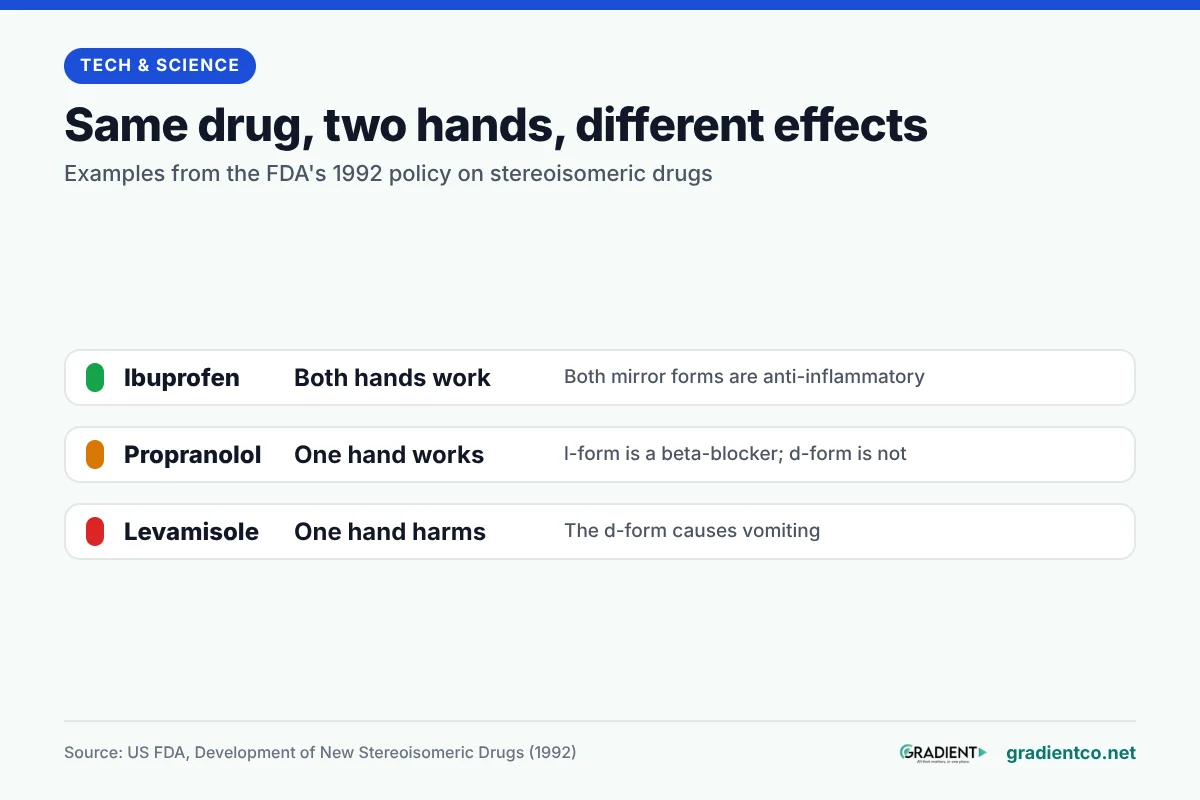
The FDA’s 1992 policy on stereoisomeric drugs gives real examples. Both mirror forms of ibuprofen are anti-inflammatory. But l-propranolol is a beta-blocker while d-propranolol is not, and the d-form of levamisole causes vomiting. The FDA also notes that selling 50:50 mixtures has “resulted in few recognized adverse consequences”, so a racemic medicine is not unsafe by default.
Thalidomide is the best-known historical case. NobelPrize.org describes a scandal in the early 1960s, when thousands of children were born with birth defects caused by this sedative. The FDA’s history office notes that its reviewer Frances Kelsey refused to approve it, so it was never sold in the United States.
NobelPrize.org says researchers later concluded that “the active substance’s mirror image” caused the harm. That lesson showed chemists why pure single forms matter.
This section explains chemistry. It is not medical advice, so talk to a doctor or pharmacist about any medicine you take. If you are interested in how medicines can lose their power over time, our piece on the era of anti-microbial resistance covers antibiotics.
What did Henri Kagan discover in 1986?
Kagan showed that an impure catalyst can still give a purer product. Many reactions that make chiral molecules use a catalyst with two parts: a metal atom that drives the reaction and a chiral molecule that steers it. Chemists assumed a straight-line rule: the purer the catalyst, the purer the product, in strict proportion.
Purity here means the excess of one hand over the other. A 50:50 mix has no excess, and one hand alone is a 100% excess.
Kagan, at Université Paris-Sud, doubted that rule. He guessed the metal holds at least two chiral molecules at once, so a mixed catalyst comes in three versions: right-right, left-left and left-right. In his tests, the left-right version worked far more slowly than the other two, says NobelPrize.org. So it did little of the work, and the majority hand won by more than expected.
When he plotted catalyst purity against product purity, he got a curve instead of a straight line. That is the “non-linear effect”. In 1986 he reported it in three reactions in the Journal of the American Chemical Society.
Others soon found big versions of the effect. Ryoji Noyori’s group got a product with a 98% excess from a guiding molecule with only a 15% excess, says the scientific background. Today chemists use the effect to see how a reaction runs and to tune it.

How does the Soai reaction work?
The Soai reaction is a molecule that copies itself and favours its own hand. Soai, at the Tokyo University of Science, saw that a reaction’s product looked a lot like its catalyst. He hunted for a chiral molecule that could make more of itself, and found one: a 5-pyrimidyl alkanol.
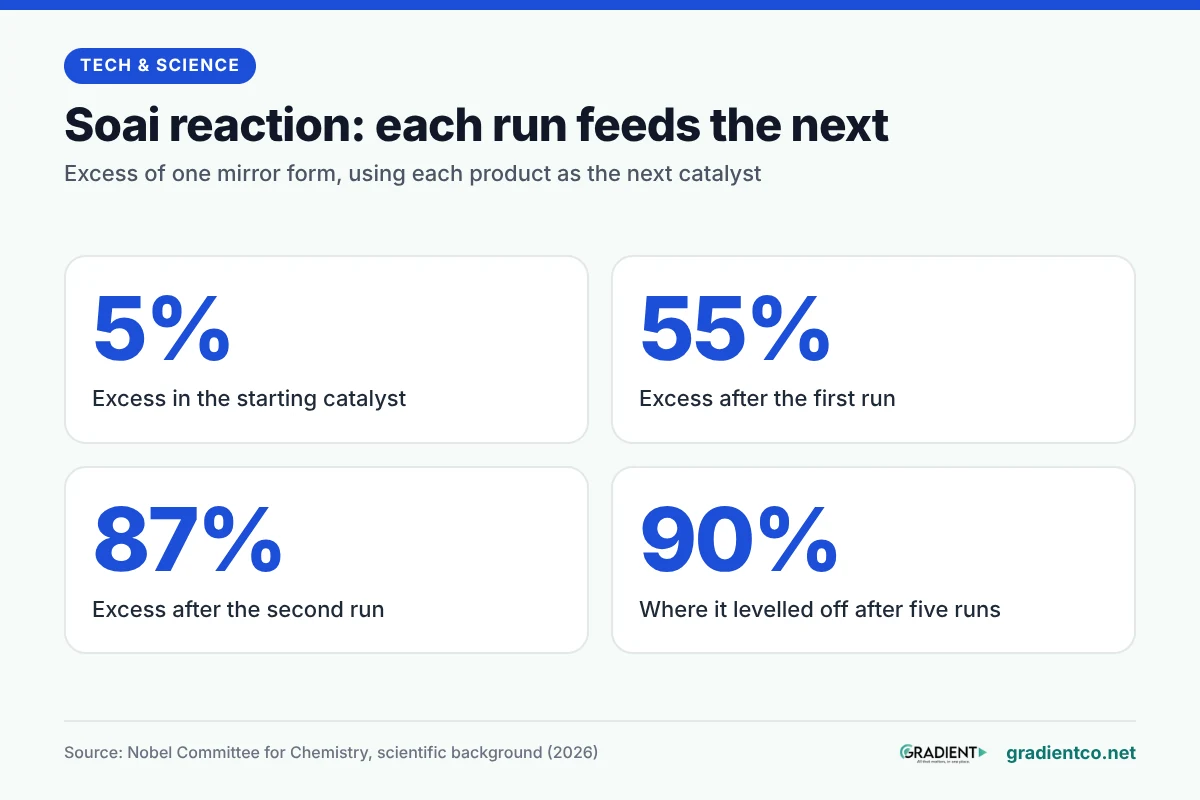
In his 1995 paper in Nature, a small 2% excess of one mirror form grew as the reaction made more of it. The committee’s scientific background walks through one series of runs from that work:
- Start with a catalyst that has a 5% excess of one mirror form.
- That form makes more of itself and outpaces its twin. The first run gave a 55% excess.
- Use the new product as the catalyst for the next run. The excess rose to 87%.
- Repeat. After five runs, the excess levelled off at 90%.
The most striking result came later. Starting from an excess of just 0.00005%, three runs gave a product with an excess above 99.5%, an amplification by a factor of 630,000, the scientific background reports.
In 2003, Soai showed the reaction could start with no chiral input at all. Chance made slightly more of one form, and that form took over. Ultimately, says NobelPrize.org, it can make up 99.99 per cent of the product.
Which hand wins is random. In a set of 37 such experiments, 18 gave one mirror form and 19 gave the other, with the excess ranging from 15% to 91%. That coin-flip behaviour is exactly what Frank’s 1953 model predicted.
Does this explain the origin of life?
Not directly; it shows one way the first imbalance could have been amplified. The committee is careful here: its scientific background says the Frank model “is not an answer to the origin of biological homochirality”. It is one possible solution among several to an event about 3.5–4 billion years ago, to which “we will probably never have a definitive answer”.
The Soai reaction is artificial and runs on zinc reagents, which is different from the chemistry of life. The committee calls it “an important proof of concept” that is not relevant to homochirality in watery systems. Researchers are now trying to repeat Soai’s trick with amino acids and sugars, says NobelPrize.org.
Soai himself told the Nobel committee, as quoted by Scientific American, “This is not the final answer.” In our view, that is the right way to read the prize. If you came here asking what is chirality and why it won a Nobel, the answer is a big step in understanding mirror image molecules, not a solved origin story.
Frequently asked questions
What is chirality in simple words?
Chirality is handedness. A chiral molecule has a mirror image that cannot be laid exactly on top of it, like your left and right hands. The two forms are called enantiomers.
Who won the Nobel Prize in Chemistry 2026?
Henri B. Kagan of France and Kenso Soai of Japan, announced on 7 October 2026. They won “for the discovery of non-linear effects and autocatalysis in asymmetric organic synthesis” and share 12 million Swedish kronor.
What is homochirality?
Homochirality means using only one mirror form of a molecule. Living things build proteins from one form of amino acids and DNA from one form of sugar, and nobody knows for certain how this began.
What is the Soai reaction?
It is a reaction in which a chiral product catalyses its own formation and favours its own hand. A tiny chance excess of one mirror form can grow until, according to NobelPrize.org, it makes up 99.99 per cent of the product.
Why do mirror image molecules matter in medicines?
The body can tell the two forms apart. One form of a drug may treat the illness while the other does nothing or causes side effects, so drug makers often aim for a single, pure form.
What we do not know yet
We could not find a primary source on how thalidomide’s two mirror forms behave in the body, so we report only what NobelPrize.org states. The two Nobel documents also give slightly different figures for Soai’s 1995 runs; we use the scientific background’s. How the Soai reaction works in detail is still debated, with two competing models. How life’s homochirality began remains open.
Read next: Atoms of Life, our look at the elements every living thing is built from.
Researched and drafted with AI assistance; facts checked against the sources linked in this article.