
The petrol price in Pakistan is the imported cost of the fuel plus fixed government charges and margins. On 3 October 2026 a litre cost Rs 392.76: about Rs 255 was the fuel landed at Karachi port, Rs 85 was petroleum and climate support levy, Rs 25 was customs duty, and about Rs 26 went on transport and company and dealer margins. The Oil and Gas Regulatory Authority (OGRA) now recalculates it every working day.
What goes into the petrol price in Pakistan?
Every litre is built in layers, and OGRA shows each one. Its daily price publication for 3 October 2026 starts with the international price of petrol and ends with the pump price. Each line has a short formula and a note on what it means.
The starting point is the Platts Arab Gulf Mean price for 92 RON gasoline, averaged over the last seven working days. OGRA adds a premium for freight and the supplier’s cut. It turns barrels into litres (one barrel holds 158.98 litres) and dollars into rupees. Then the government’s charges and the trade’s margins go on top.
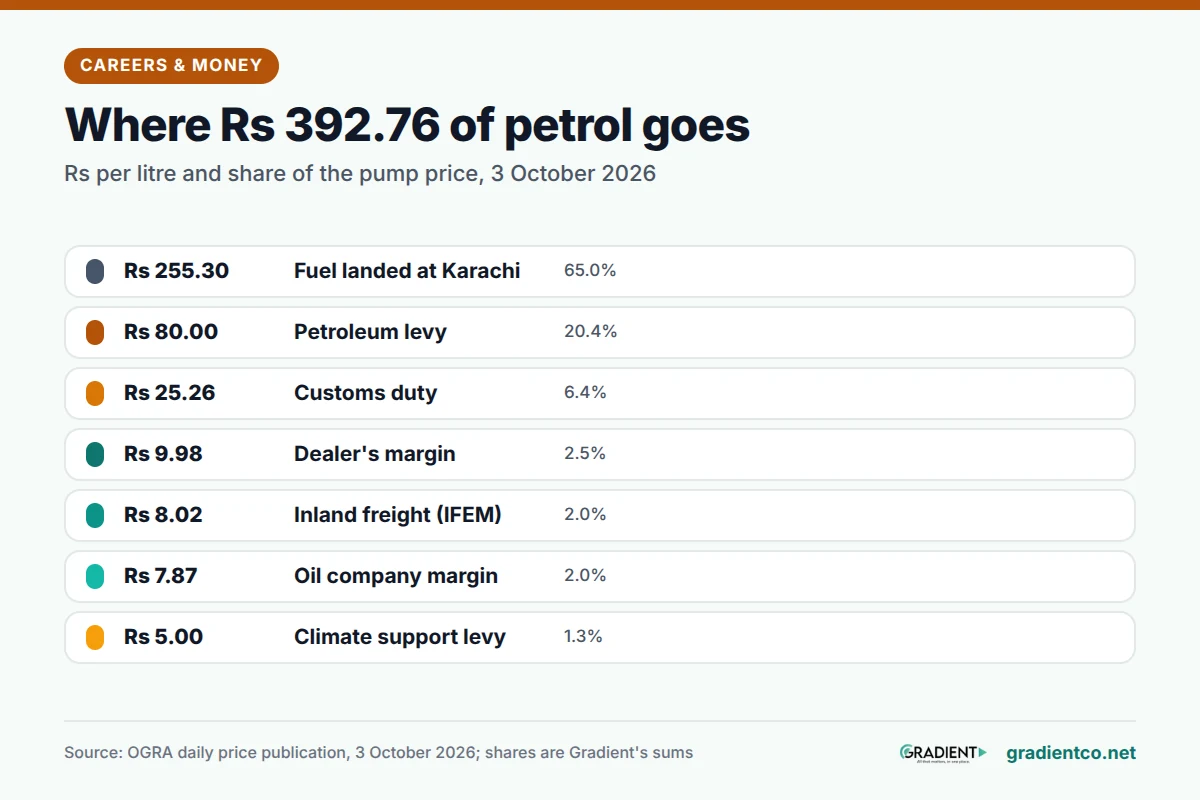
| Petrol price breakdown, 3 October 2026 | Rs per litre | Share of pump price |
|---|---|---|
| Fuel cost landed at Karachi port | 255.30 | 65.0% |
| Exchange rate adjustment | 1.33 | 0.3% |
| Customs duty | 25.26 | 6.4% |
| Inland freight equalisation margin (IFEM) | 8.02 | 2.0% |
| Oil marketing company margin | 7.87 | 2.0% |
| Dealer’s margin | 9.98 | 2.5% |
| Petroleum levy | 80.00 | 20.4% |
| Climate support levy | 5.00 | 1.3% |
| Sales tax | 0.00 | 0% |
| Pump price (before secondary freight) | 392.76 | 100% |
The rupee figures are OGRA’s; the shares are our own sums. The total leaves out “secondary freight”, the cost of trucking fuel from a depot to a pump. That is why prices can be a little higher far from a depot.
How much of each litre is tax?
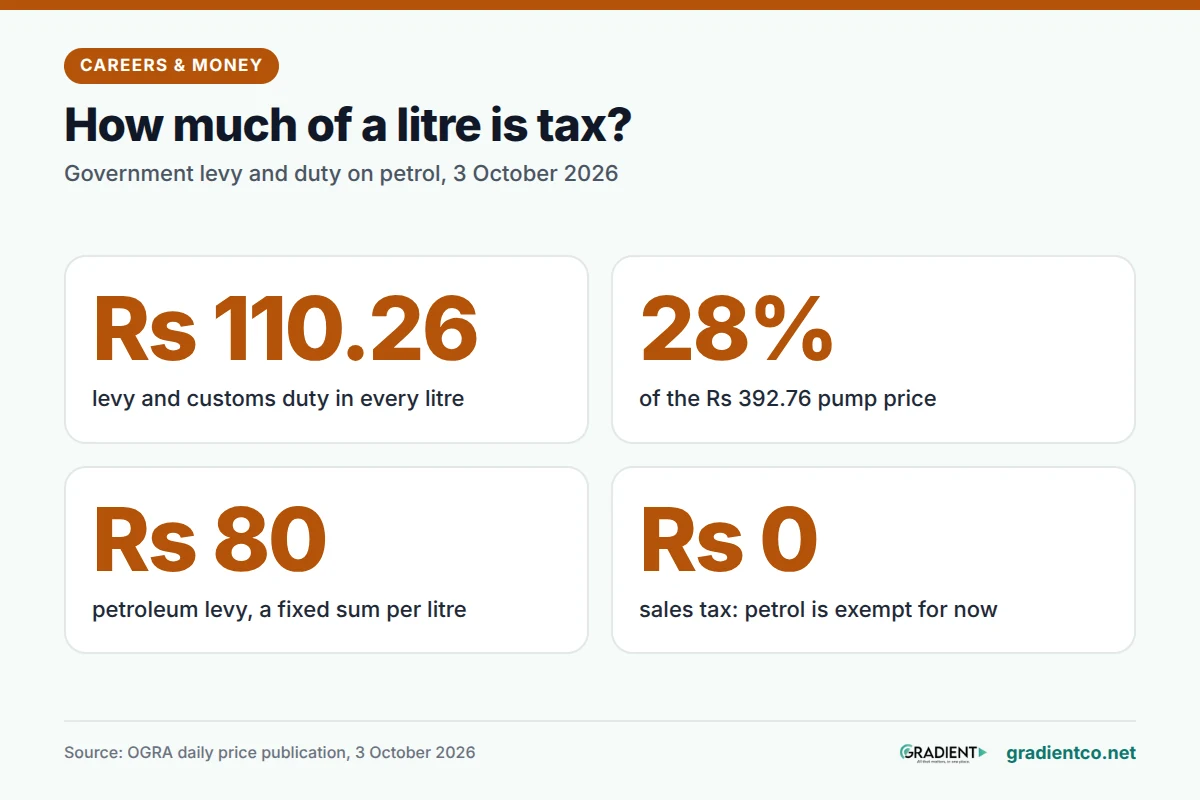
On 3 October 2026, Rs 110.26 of every litre, about 28%, was government levy or duty. That is the petroleum levy (Rs 80), customs duty (Rs 25.26) and the climate support levy (Rs 5). Petrol carries no general sales tax at the moment: OGRA’s build-up says “Currently, Petrol is exempted from Sales Tax.”
The petroleum levy is the biggest charge after the fuel itself. The federal government notifies both levies under the Petroleum Products (Petroleum Levy) Ordinance, 1961, which OGRA’s build-up cites for each of them. Customs duty is charged under the Customs Act, 1969.
The levy is a fixed sum per litre, not a share of the price, so it does not rise when oil gets dearer. It does change when the government issues a new order. On 1 July 2026 the climate support levy doubled from Rs 2.50 to Rs 5 a litre, and the petroleum levy was cut by Rs 2.50 to keep the pump price unchanged, The Nation reported. The levy on petrol was Rs 64.14 then and stood at Rs 80 in early October.
Diesel is built the same way. It cost Rs 399.64 on 3 October, with the same Rs 80 and Rs 5 levies but less customs duty, at Rs 15.68.
Who sets the petrol price in Pakistan?
OGRA works out the price and posts it; the federal government sets the levies and the margins. OGRA works under the Oil and Gas Regulatory Authority Ordinance, 2002, and its notifications cite that law. The company and dealer margins are, in OGRA’s words, “fixed by the Government”.
The petroleum levy rate comes from the Ministry of Energy (Petroleum Division). OGRA’s notification of 2 October 2026, which set the kerosene oil price, applies the petroleum levy “as notified” by a Petroleum Division order dated 21 August 2026. According to The News, the levy cannot exceed a limit approved by the federal cabinet, and any change in its rate needs Finance Division approval.
In short, three bodies share the job:
- OGRA: runs the formula every working day and publishes the result.
- Petroleum Division: notifies the levy and announces the new rates.
- Finance Division and the cabinet: approve changes to the levy and set its ceiling.
Why does the petrol price change every few days now?
Since July 2026, OGRA has set fuel prices daily instead of weekly. Petroleum Minister Ali Pervaiz Malik announced on 17 July 2026 that the Prime Minister and federal cabinet had given OGRA this job, Radio Pakistan reported. OGRA would publish prices on its website and “disclose all components that make up the final retail price”.
Daily pricing replaced a weekly review that had itself replaced the older fortnightly one, according to a PTI report carried by Outlook India. Government guidelines to OGRA keep prices unchanged on Saturdays and Sundays, ARY News reported, so Friday’s price runs through the weekend.
The first week of October 2026 shows how this works:
| Effective date | Petrol, Rs per litre | Change |
|---|---|---|
| 1 October 2026 | 387.40 | – |
| 2 October 2026 | 390.66 | up Rs 3.26 |
| 3 to 5 October 2026 | 392.76 | up Rs 2.10 |
The levies did not move during those days; they stayed at Rs 80 and Rs 5 in OGRA’s publications for 1 October, 2 October and 3 October. The rise came from the fuel cost. The seven-day Platts average climbed from USD 127.74 to USD 130.17 a barrel, and OGRA cited “changes in Platts rates, premiums and incidentals”, according to Profit.
Because each input is a seven-day average, changes arrive in small steps. OGRA says the “full impact of revision in daily international price is passed-on in seven working days”.
What moves the petrol price in Pakistan most?
The world oil price and the rupee move the price day to day; the levy moves it in larger, less frequent steps. Using OGRA’s 3 October figures, our arithmetic gives these rough rules of thumb:
- Oil: each extra US dollar per barrel on the cost-and-freight price adds about Rs 1.74 a litre, before customs duty.
- The rupee: each rupee the dollar gains adds about Rs 0.92 a litre. OGRA uses a seven-day average of the State Bank of Pakistan rate, which was Rs 277.27 per dollar in the 3 October build-up.
- The levy: a change of Rs 5 in the petroleum levy changes the pump price by exactly Rs 5, because it is a fixed amount per litre.
Margins and IFEM shift less often. IFEM is, in OGRA’s words, the “weighted average cost of transporting the product across the country”, so one national transport figure goes into the petrol price in Pakistan. It was Rs 7.91 on 1 and 2 October and Rs 8.02 on 3 October.
If rising fuel costs have you weighing other ways to get around, our look at the impact of electric vehicles on Pakistan covers the alternative.
How do you read an OGRA price notification?
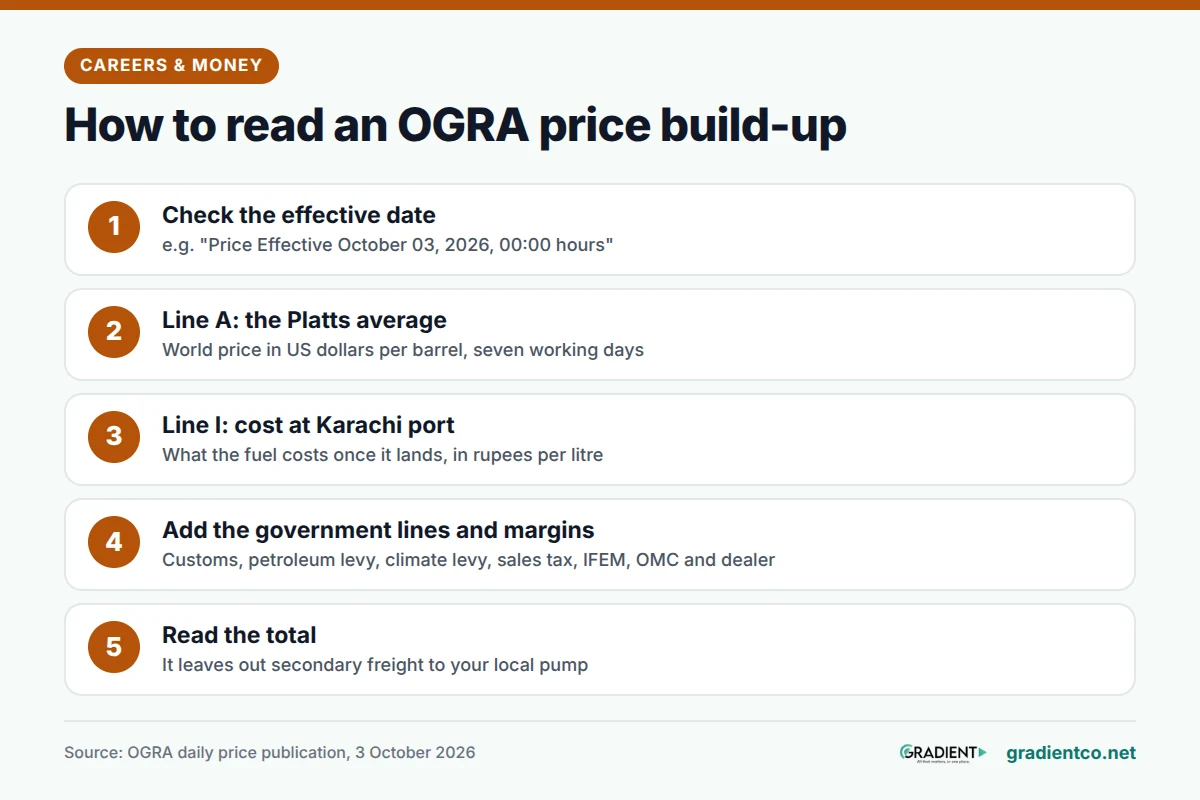
Look for the effective date first, then read the build-up from top to bottom. OGRA’s site has two lists: daily price publications with the full build-up, and formal notifications that are published in the Gazette of Pakistan.
- Check the effective date and time. The 3 October build-up says “Price Effective October 03, 2026, 00:00 hours”.
- Find line A, the Platts average in dollars per barrel. This is the world price, already averaged over seven working days.
- Find line I, the cost at Karachi port. This is what the fuel costs once it lands in Pakistan, in rupees per litre.
- Add the government lines: customs duty, petroleum levy, climate support levy and sales tax.
- Add the margins: IFEM, the oil marketing company margin and the dealer’s margin.
- Read the total, and remember it excludes secondary freight to your local pump.
A formal notice adds one useful detail. OGRA’s 2 October notice for kerosene oil says its maximum depot price applies at 23 company depots and covers only the first leg of freight. Beyond those depots, and in special areas of Balochistan, Azad Kashmir and the Northern Areas, companies may add secondary freight up to the pump.
Frequently asked questions
What is the petrol price in Pakistan today?
It changes on working days, so check OGRA’s latest price publication. As an example, petrol cost Rs 392.76 a litre from 3 to 5 October 2026.
How much tax is in a litre of petrol in Pakistan?
On 3 October 2026, Rs 110.26 a litre, about 28% of the price. That was Rs 80 petroleum levy, Rs 25.26 customs duty and Rs 5 climate support levy; petrol was exempt from sales tax.
Who decides petrol prices in Pakistan?
OGRA calculates and publishes the price every working day. The federal government, through the Petroleum Division and Finance Division, sets the petroleum levy and fixes the company and dealer margins.
How often does the petrol price change in Pakistan?
Every working day since July 2026, when daily pricing replaced the weekly review. Prices notified on Friday stay unchanged on Saturday and Sunday.
Why is diesel more expensive than petrol in Pakistan?
On 3 October 2026, diesel cost Rs 399.64 against Rs 392.76 for petrol because diesel’s import cost was higher. The levies were the same Rs 80 and Rs 5, and diesel’s customs duty was lower.
What we do not know yet
We could not open the State Bank of Pakistan’s exchange-rate pages, so the dated rate here comes from OGRA’s build-up. We did not read the Finance Act’s legal ceiling for the petroleum levy, or each notification that moved the levy from Rs 64.14 in July to Rs 80 in October. We will add them when we can source them.
Read next: The impact of electric vehicles on Pakistan, and how human activity drives climate change, the cause the climate support levy is named for.
This article is general information, not financial advice. Researched and drafted with AI assistance; facts checked against the sources linked in this article.