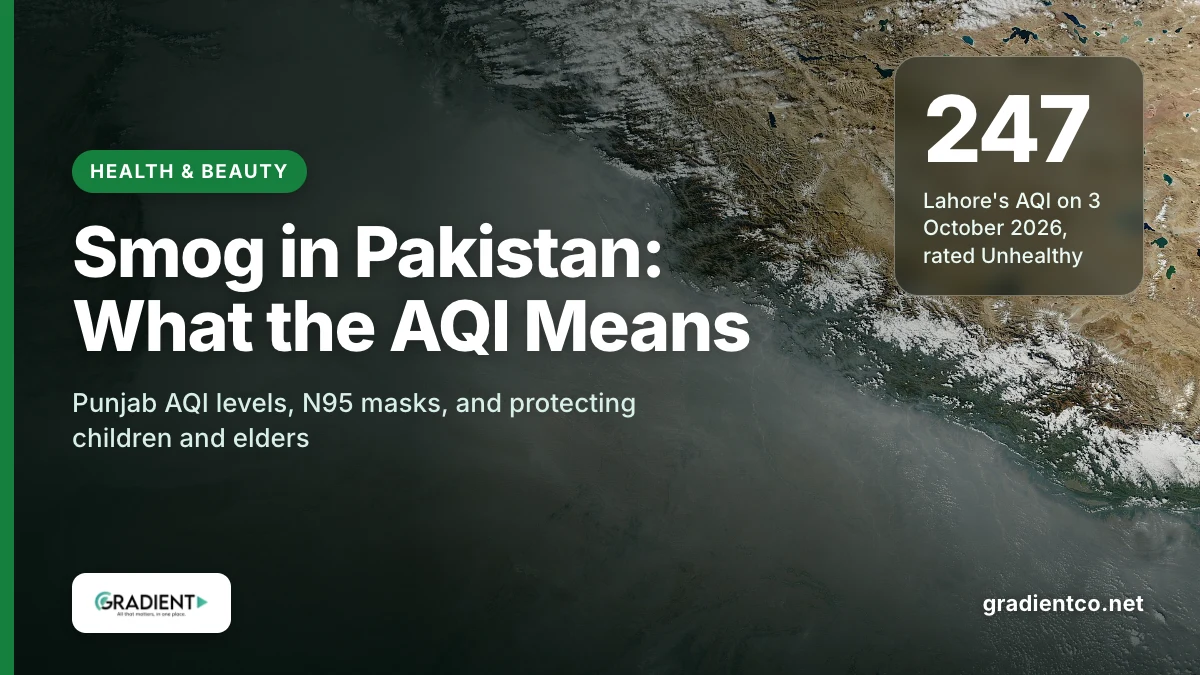
Smog in Pakistan is measured with the Air Quality Index (AQI), and on the Punjab government’s scale anything above 200 is “Unhealthy”: everyone may feel effects, and children, elders and people with asthma or heart conditions should stay indoors. Lahore read 247 at 11:00 PM on 3 October 2026. Check your city’s number each morning, wear an N95 mask if you must go out, and keep windows closed.
What do the AQI numbers mean in Pakistan?
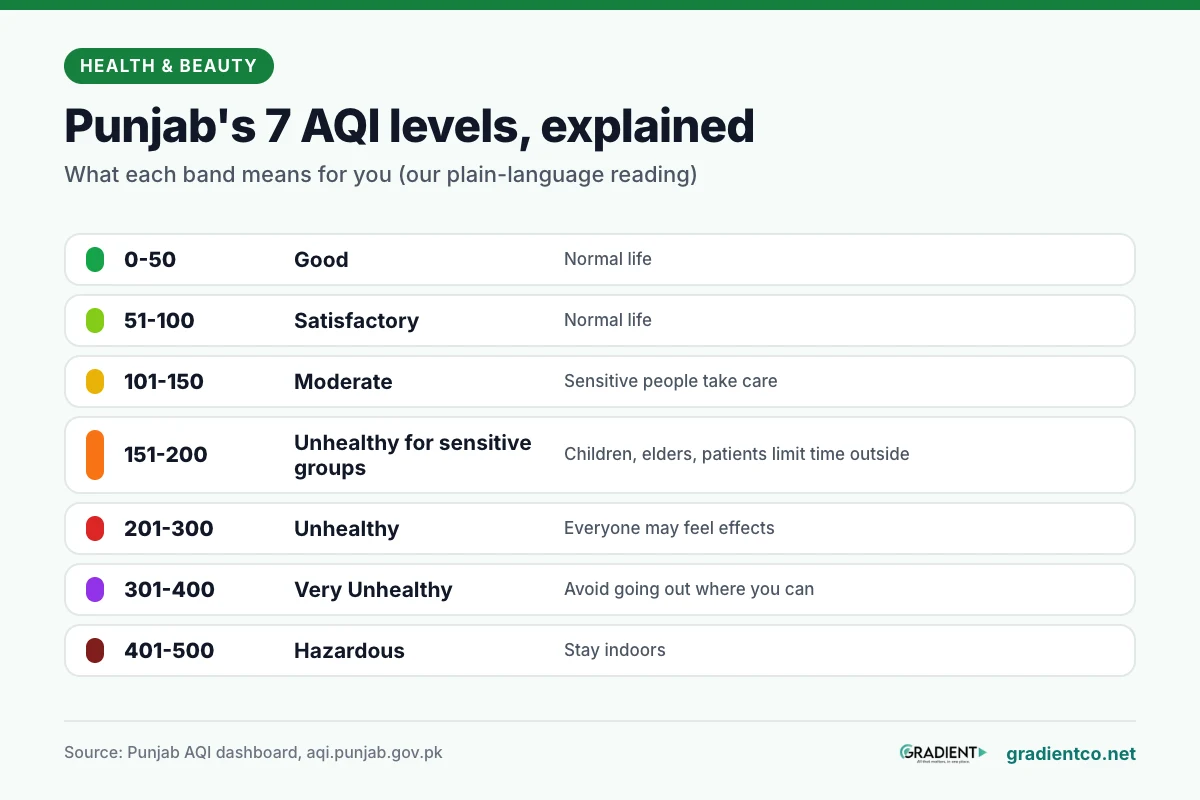
The AQI turns pollution readings into one number from 0 to 500, and a higher number means dirtier air. The Punjab AQI dashboard splits it into seven bands.
| AQI | Punjab category | What it means for you |
|---|---|---|
| 0-50 | Good | Normal life |
| 51-100 | Satisfactory | Normal life |
| 101-150 | Moderate | Sensitive people take care |
| 151-200 | Unhealthy for sensitive groups | Children, elders and patients limit time outside |
| 201-300 | Unhealthy | Everyone may feel effects |
| 301-400 | Very Unhealthy | Avoid going out where you can |
| 401-500 | Hazardous | Stay indoors; the worst band |
The last column is our plain-language reading of the bands, not the dashboard’s wording. The official wording for “Unhealthy” is that “everyone may begin to experience health effects; sensitive groups may experience more serious effects”, according to the Punjab AQI page for Lahore.
Bands differ between countries. The US EPA’s AirNow scale calls 151-200 “Unhealthy” and 201-300 “Very Unhealthy”, so it is stricter than Punjab’s. If you read a foreign app, check which scale it uses before you compare numbers.
How bad is smog in Pakistan right now?
Bad enough that Lahore sits in the Unhealthy band. The Punjab dashboard showed Lahore at AQI 247 at 11:00 PM on 3 October 2026, with its forecast for the early hours of 4 October falling from 224 at midnight to 182 by 7:00 AM.
Readings vary a lot by neighbourhood. The Multan Road station showed AQI 500, the Hazardous band, with PM2.5 at 174.9 micrograms per cubic metre and PM10 at 575.9. A city-wide figure can hide a much worse street near you.
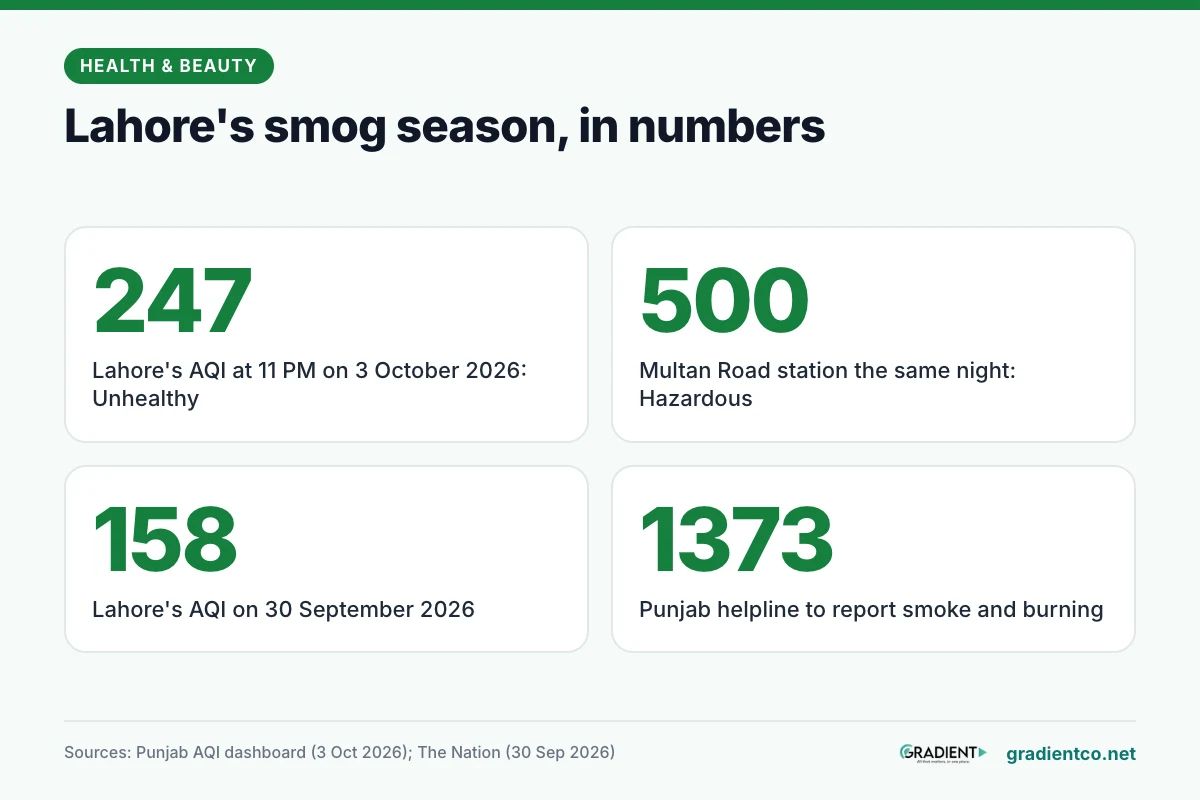
The season is only starting. Lahore was at 158 on 30 September, according to The Nation, as officials inspected 431 brick kilns and 269 industrial units in 24 hours.
In November 2025, the National Institute of Health (NIH) described Lahore, Multan, Gujranwala, Rawalpindi and Islamabad as recording hazardous levels, with Lahore often above 400. The report confirms 400-plus readings only for Lahore. We cannot say what this winter will bring.
Why is PM2.5 the number that matters?
PM2.5 is the main reason smog in Pakistan harms health, because the particles are tiny enough to reach deep into the body. The US Environmental Protection Agency defines them as particles 2.5 micrometres across or smaller, about 30 times thinner than a human hair, and says they pose the greatest risk to health.
The World Health Organization (WHO) says fine particles can pass from the lungs into the bloodstream and affect all major organs. It links them to stroke, lung cancer and chronic obstructive pulmonary disease (COPD).
Globally, WHO estimates that outdoor air pollution caused 4.2 million premature deaths-air-quality-and-health) in 2019. It also found that 99% of people lived where WHO guideline levels were not met.
When should you wear an N95 mask?
Wear one whenever you must be outside and the air is Unhealthy or worse, and always if you are in a sensitive group. The Punjab dashboard advises everyone to wear a face mask outdoors, and tells at-risk people to use an N95 if going out is necessary. The NIH advisory also recommends N95 or KN95 masks outside.
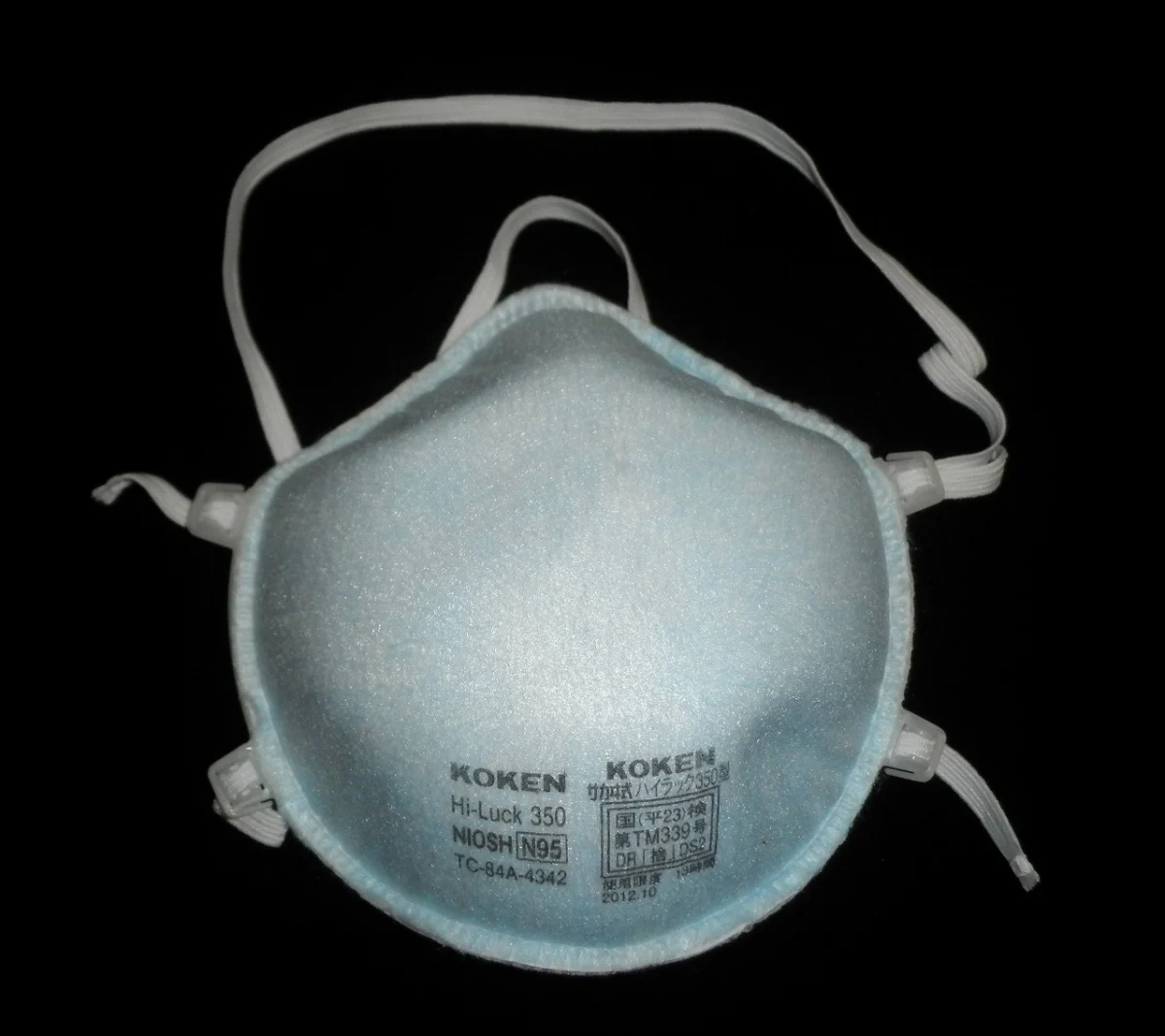
An N95 only works if it seals. The US CDC’s respirator page says N95s filter at least 95% of airborne particles, that effectiveness “depends heavily on proper fit and use”, and that you should do a seal check each time. We did not find a source that rates cloth or surgical masks for smog, so we cannot say how they compare.
People with COPD or heart disease should ask a doctor first, as the dashboard advises, because the dashboard asks them to consult a doctor about mask use.
How do you protect children and elders from smog?
Keep them indoors on bad days, with windows closed. The Punjab dashboard says children, elderly people and those with asthma or heart conditions should avoid outdoor activity altogether when the air is Unhealthy.
Children are more exposed than adults. WHO says they breathe more rapidly and live closer to the ground, where some pollutants peak, and that 93% of children under 15 worldwide (about 1.8 billion, in WHO’s 2018 report) breathed fine-particle air above its guideline levels.
Here is a simple routine for a smoggy day:
- Check the AQI for your city before school runs and morning walks.
- Move play, sport and school assemblies indoors above AQI 150.
- Keep windows and doors shut, and use a HEPA filter purifier if you have one, as the NIH suggests.
- Avoid smoke indoors, including cigarettes.
- If you must go out, keep trips short and wear your N95.
- Call a doctor if coughing, wheezing or chest tightness gets worse.
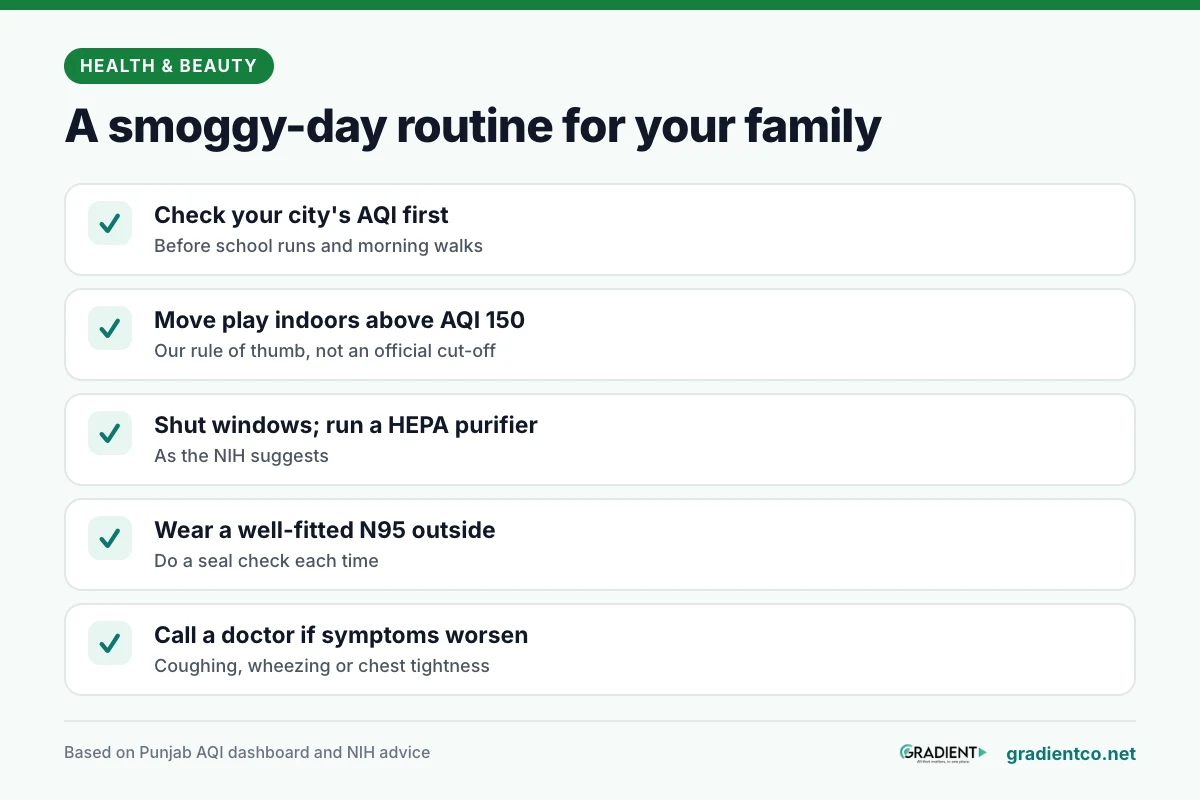
Moving play indoors above AQI 150 is our own rule of thumb, based on the Punjab advice to keep children indoors; it is not an official cut-off. For other seasonal habits, see our guide to surviving winter.
What can you do about smoke near you?
You can report it. Punjab officials urged residents to report violations by calling helpline 1373, according to The Nation. In the 24 hours to 30 September, the same report says, inspectors sealed 9 brick kilns, demolished 5 and sealed 11 industrial units, and officials contacted over 215,000 farmers about crop-residue burning.
Pollution is also a long-term problem that individuals cannot fix. Our piece on ways to control environmental pollution covers habits that help.
Frequently asked questions
What AQI is dangerous in Pakistan?
On the Punjab scale, 151 and above is unhealthy for sensitive groups, 201 and above is Unhealthy for everyone, and 401 and above is Hazardous.
Do I need an N95 mask for smog in Pakistan?
Wear one when you must go outside in Unhealthy air or worse. Punjab’s dashboard recommends an N95 for at-risk groups, and the NIH recommends N95 or KN95 masks.
Is smog worse for children?
Yes. WHO says children breathe more rapidly than adults and live closer to the ground, where some pollutants peak.
What is the difference between PM2.5 and PM10?
PM2.5 particles are 2.5 micrometres or smaller, and PM10 particles are 10 micrometres or smaller. The EPA says the smaller ones pose the greatest health risk.
Where can I check Lahore’s AQI?
The Punjab government’s AQI dashboard at aqi.punjab.gov.pk shows live readings by city and station.
What we do not know yet
We could not confirm the WHO’s numeric 2021 limits for PM2.5, because its page shows them only in an image. We also did not find official advice on N95 sizes for children, Pakistan-specific retail prices for masks and purifiers, or how bad smog in Pakistan will get this season.
This article is general information, not medical advice. Talk to a doctor before changing your diet, exercise or medication.
Read next: 5 ways to survive winter.
Researched and drafted with AI assistance; facts checked against the sources linked in this article.