
Osteoporosis in Pakistan is common but rarely noticed in time, because the disease thins bones without pain until one breaks after a minor fall. Women after menopause and older men face the highest risk, and too little calcium or vitamin D adds to it. Several Pakistani studies have found very low vitamin D in women. A DEXA scan confirms the disease, and food, safe sun, exercise and a fall-proof home help protect bones at any age.
What is osteoporosis, and why is it called silent?
Osteoporosis means “porous bone”: bones lose density and strength until a small knock can break them. The International Osteoporosis Foundation (IOF) calls it the “silent disease” because most people only find out after a fragility fracture, a break from a fall or bump that would not hurt healthy bone. Its World Osteoporosis Day 2026 toolkit says the disease is “vastly underdiagnosed and undertreated.”
So most osteoporosis symptoms are really the results of a break. The UK’s National Health Service (NHS) says the condition is “not usually painful until a bone is broken.” The wrist, the hip and the bones of the spine break most often. When spinal bones collapse, some older people develop a stooped back.
Two signals are easy to brush off, the IOF’s patient guide warns: back pain, and a wrist broken in a fall from standing height. Only 1/3 of spine fractures come to a doctor’s attention, according to the toolkit.
Who is most likely to get osteoporosis?
Women and people over 50 carry most of the risk. According to the IOF’s epidemiology page, 1 in 3 women and 1 in 5 men over 50 will have a fracture caused by osteoporosis. Worldwide that adds up to over 500 million people living with the disease and up to 37 million fractures a year in people over 55, about 70 a minute. Bone loss speeds up after menopause, because oestrogen helps protect bone.
Some risk factors are fixed. The IOF risk factor list includes a parent with osteoporosis or a hip fracture, menopause before 45 or a hysterectomy, rheumatoid arthritis, and steroid tablets taken for three months or more. It notes that around 75% of osteoporotic fractures happen in people aged 65 and older.
Others can change. Smoking “almost doubles the risk of hip fracture,” the IOF says, and more than 2 units of alcohol a day also raises fracture risk. A body mass index (BMI) below 19, an inactive life, a poor diet and vitamin D deficiency all add to it. If you smoke, that’s the change with the clearest payoff in our view.
What do studies show about osteoporosis in Pakistan?
As of October 2026 we found no recent national count, but local studies keep finding weak bones and very low vitamin D in women. The only national estimate we found is old. A 2013 paper in the Journal of the Pakistan Medical Association (JPMA) cites an IOF audit from 2009: about 9.9 million people in Pakistan had osteoporosis, 7.2 million of them women. In the same paper’s study of 660 people aged 10 to 80 at a Lahore hospital’s outpatient clinic, a heel ultrasound suggested osteoporosis in 18.6% and low bone mass in 64.1%.
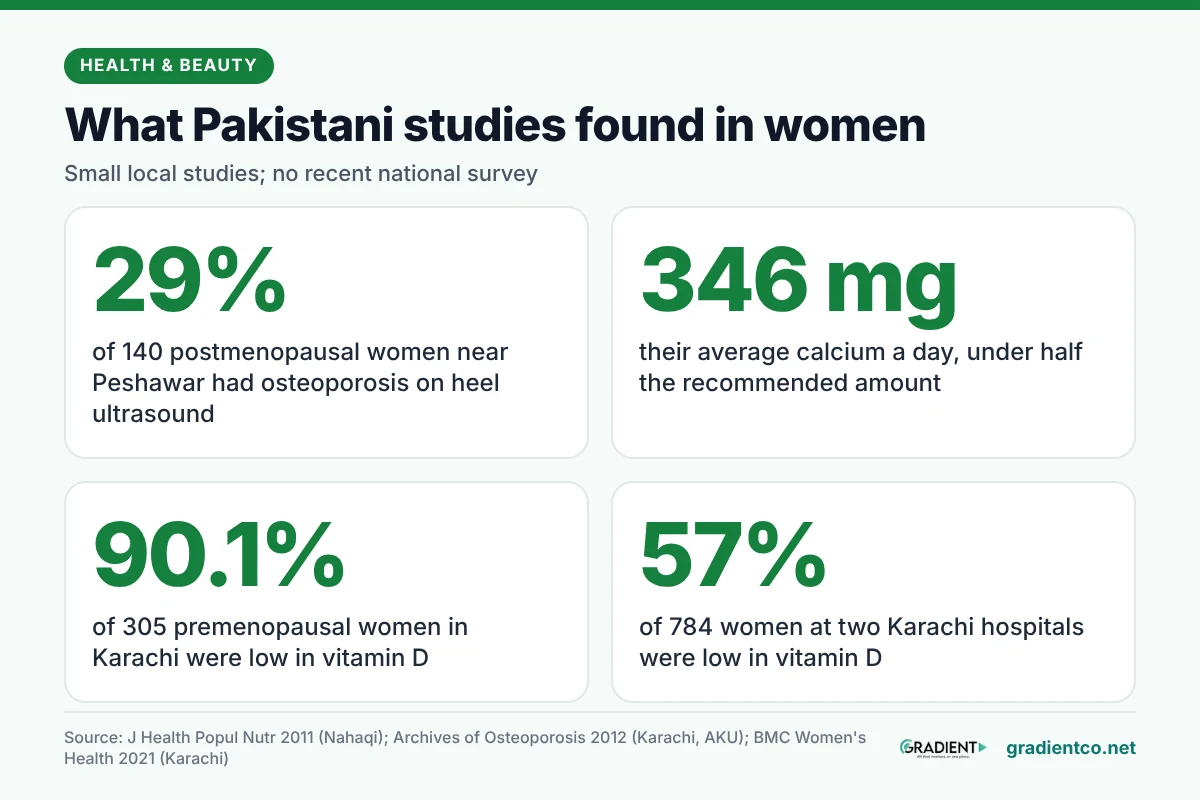
Rural women show the same pattern. In Nahaqi, a village near Peshawar, researchers studied 140 postmenopausal women aged 41 to 67 for the Journal of Health, Population and Nutrition in 2011. Heel ultrasound scores pointed to low bone mass in 42% and osteoporosis in 29%. Their average calcium intake was 346 mg a day, less than half the recommended amount, and only nine of the 37 women tested had vitamin D above the study’s cut-off.
Vitamin D deficiency turns up even in young, healthy women. We think the two Aga Khan University studies from Karachi, both in Archives of Osteoporosis in 2012, matter most for readers here, because these women were healthy and not hospital patients:
- A community study of 305 premenopausal women in Saddar, Gulshan and Malir Town found 90.1% were deficient. Age, the part of town and the type of housing predicted their levels.
- A study of 174 healthy volunteers found deficiency in 82.8% and enough vitamin D in just 1.1%. Time in the sun and wearing a veil were linked to bone health.
A larger 2021 study of 784 women at two Karachi hospitals, in BMC Women’s Health, found deficiency in 57%. It was more common in women under 35, in poorer households and in winter.
The cause is less settled than many claims online suggest. The Nahaqi authors thought the full burqa worn outdoors was the most likely reason, but they did not measure sun exposure. In the 2021 study, covering up was linked to deficiency only before other factors were taken into account.
You don’t need a national figure for osteoporosis in Pakistan to act on this pattern. In our view, if you’re a woman who rarely spends time in the sun, a vitamin D blood test is worth raising with your doctor.
How do doctors test for osteoporosis?
A DEXA scan, a low-dose X-ray of the hip and spine, is the standard test, and a risk calculator often comes first. Rehman Medical Institute (RMI) in Peshawar says the scan is painless, needs no injection or special preparation, and usually takes 10 to 20 minutes.
- Risk check. Your doctor asks about age, past fractures, family history, steroid use and other conditions, and may use an online tool such as FRAX, which estimates your future risk of breaking a bone.
- The scan. You lie on a table while a scanning arm passes over your spine and hip, and sometimes your forearm.
- The T-score. The result compares your bones with a healthy young adult’s, and the NHS sorts it into three bands, shown below.
- The plan. Your doctor weighs the score with your risk factors.

Who should have the scan differs by country. In the United States and Canada, the IOF toolkit says testing is advised for all women from 65 and men from 70, and for anyone who broke a bone after 50. In Pakistan, the Nahaqi study’s authors noted that high cost and low availability limit DEXA in primary care. RMI asks patients to call for its current price, so check before you book.
Which daily habits build and protect bone?
Food, sun, movement and a safer home all count, and it’s never too late to start. This year’s World Osteoporosis Day, on 20 October, runs under the theme “Build, Protect and Strengthen Your Bones for Life”, which is a fair outline of this section. Up to 90% of peak bone mass is in place by about 20, so the teenage years matter most. See our guide to a healthy platter for teenagers.

Calcium from food
For calcium, IOF guidance lists 1000 mg a day for adults aged 19 to 50 and 1200 mg for women after menopause, and prefers food to supplements. The NHS sets a lower bar, 700mg a day for adults, which it says you should be able to get from your daily diet. Milk, yoghurt and cheese are the familiar sources. Leafy greens, almonds, tofu and tinned fish eaten with their soft bones add more.

Vitamin D and safe sun
Vitamin D helps your body absorb calcium, and the IOF says most of it comes from sunlight on the skin. The NHS suggests a short time in the sun each day, and notes that it can be hard to get enough from food alone. Oily fish, eggs and mushrooms help. Whether you need a supplement, and how much, is a question for your doctor, ideally after a blood test.
Weight-bearing exercise
Bones get stronger when you use them, and the IOF suggests 30 to 40 minutes three to four times a week, mixing weight-bearing moves with resistance work. The NHS gives running, skipping, dancing and aerobics as high-impact examples. Our daily workout guide is an easy place to begin.

If you already have osteoporosis, ask for a plan that also trains balance and posture.
A fall-proof home
A fragility fracture usually follows a fall or a bump, which is why the home belongs on this list. The World Health Organization says adults over 60 suffer the most fatal falls, and recommends balance training and fixing hazards at home. In our view, good lighting on stairs, no loose rugs and a grab rail in the bathroom are simple places to start.
When does a broken bone call for a bone check?
If you break a bone after 50 in a minor fall, ask your doctor to check you for osteoporosis. One fragility fracture roughly doubles the chance of another, the IOF says. After a spine fracture, about 20% of untreated women break another spinal bone within a year.
Raise it too if you have lost 4 cm or more in height, which the IOF lists as a possible sign of a spine fracture, or have any of the fixed risk factors above. Treatment, if you need it, is a decision for you and your doctor, not something to start on your own.
Frequently asked questions
Can young people get osteoporosis?
Yes, but it’s less common: the NHS says osteoporosis can also affect younger women and children, and the IOF’s risk list includes eating disorders, rheumatoid arthritis and long-term steroid use. The bigger concern for the young is building enough bone: the IOF says 40–60% of total bone mass is built during puberty.
Do men get osteoporosis?
Yes. The IOF estimates that about 6.3% of men over 50 worldwide have osteoporosis, against 21.2% of women.
Is back pain a sign of osteoporosis?
It can be, if a spinal bone has collapsed, and the IOF warns against writing it off as normal ageing. Mention it to your doctor along with any loss of height.
Is osteopenia the same as osteoporosis?
No. Osteopenia is the stage before: bone density is below average but not yet low enough to count as osteoporosis, and the NHS says it does not always lead to osteoporosis.
What we do not know yet
We found no recent national survey of osteoporosis in Pakistan; the 9.9 million estimate goes back to 2009. We could not find a published DEXA price from a Pakistani hospital, or Pakistani government guidance on daily calcium and vitamin D, and we could not confirm whether FRAX offers a Pakistan-specific model.
This article is general information, not medical advice. Talk to a doctor before changing your diet, exercise or medication.
Read next: How to enrich the diet with 6 essential food intakes, for more on building a balanced plate.
Researched and drafted with AI assistance; facts checked against the sources linked in this article.
Featured image: Female doctor examines X-rays in a medical office in the afternoon by Shixart1985, CC BY 2.0.